

Every year the same debate plays out in kitchens, offices and group chats: what is the best Halloween candy? Ask ten people and you will get ten passionate answers, from peanut butter cups to sour gummies to the humble lollipop. The truth is that “best” depends on who is asking. The best candy for a kid with a sweet tooth is not the best for a parent trying to keep the bowl nut-free, and neither may be the best for the homeowner who wants to keep a big bag affordable.
This guide is meant to help you choose. We explain how to think about Halloween candy, break down the most popular types and what each is good for, cover allergy-friendly and non-food options, and show you how much to buy and how to save. We are not going to invent survey results or claim a lab-tested ranking. Instead, you will get honest, practical guidance based on how people actually use candy on Halloween night. Halloween 2026 falls on Saturday, October 31, so there is still time to plan your bowl.
Before naming candies, it helps to decide what you are optimizing for. Different goals lead to different choices.
| Type | Why people like it | Things to consider |
|---|---|---|
| Chocolate bars and cups | Familiar favorites that are easy to recognize | Often contain milk, and many contain nuts or traces of them. Can melt in warm weather. |
| Fruity and chewy candy | Colorful, fun to eat and usually nut-free | Can be sticky and sometimes hard on teeth. |
| Sour candy | Popular with older kids and teens | Very sour candy can irritate the mouth if eaten in large amounts. |
| Lollipops and hard candy | Long-lasting, cheap and easy to hand out | Not ideal for very young children because of choking risk. |
| Gum | Small and inexpensive | Less exciting on its own, but useful as a filler. |
| Novelty and seasonal candy | Fits the Halloween theme, with special shapes and colors | Can be more expensive and may not taste better. |
| Non-food treats | Safe for children with food allergies | Not everyone will consider it a candy replacement. |
If you had to pick a single category to fill a bowl, chocolate is the obvious safe choice. Peanut butter cups, caramel-filled bars, crispy wafer bars, chocolate-covered candy shells and nougat bars are all common in trick-or-treat bags. Many chocolate brands offer “fun size” or “snack size” wrapped pieces in variety packs designed for Halloween, which is a convenient way to add several options at once.
Chocolate does have a few drawbacks. It can melt if the weather is warm or if a bowl sits in the sun. Many chocolate candies contain nuts, or are made in facilities that also process nuts, so they are not suitable for every child. Chocolate can also be more expensive per piece than other types of candy, so if you expect a big crowd, you may want to mix it with less costly options.
Because formulations and packaging change, always check the label if allergens matter to you rather than relying on a general statement about a brand.
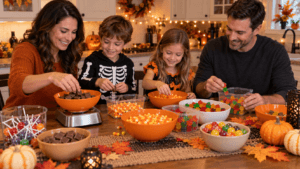
Fruity chews, gummies and jelly candies are hugely popular. They tend to be inexpensive, come in bright colors and are often made without nuts, although this is not guaranteed for every product. Some contain gelatin, which matters for vegetarian and some religious diets, so if you want to include everyone, look for products that state their ingredients clearly.
These candies are easy to hand out and easy for kids to trade. On the downside, they are sticky and tend to stay in the mouth for a long time, which can be a concern for dental health. A short reminder to brush teeth after candy is helpful for parents.
Older children and teens frequently love sour candy, whether it is sour gummies, sour belts or coated chews. It adds a bit of excitement to the bowl, but it is not for everyone. Very young children may not like it, and very sour candy can be harsh on the tongue and mouth. It is best used as one option among many, not as the main candy.
Lollipops are inexpensive, individually wrapped and tend to last a long time, which is why they show up in so many bowls. They are a good choice for big neighborhoods where you expect a steady stream of visitors. Keep in mind that they are not recommended for toddlers because of the choking risk of hard candy. If you have young visitors, consider adding something softer.
Some candies are famous for how much people love or dislike them. Candy corn is the most recognized example. Some people look forward to it every autumn, while others avoid it. Other traditional items, such as taffy, molasses chews and licorice, are also polarizing. If you want to include a nostalgic item, keep it as a small share of the mix, not the main event. Choose candies that most children will actually eat, and you will avoid the awkward sight of a bowl full of leftovers on November 1.
Food allergies affect many children, and Halloween can be stressful for families who are managing them. There are simple steps that make your house a friendlier stop.
If you are a parent of a child with allergies, plan ahead, go through the candy together after trick-or-treating and set aside anything that is not safe.
Not every treat has to be sugary. Small items can be a welcome change, especially for kids who have collected a lot of candy by the end of the night.
To keep things simple, offer a choice: a bowl of candy and a bowl of small toys. Children love choosing, and it makes your house memorable.
This is the most common practical question, and the answer depends on where you live. A neighborhood with many houses close together and lots of children will see more visitors than a quiet rural road.
To plan when the visitors will arrive, see our guide to what time trick-or-treating usually happens.
Candy is one of the biggest costs of the holiday, but a few habits make it cheaper.
If you are also shopping for costumes and decor, our Spirit Halloween savings guide explains how to plan seasonal purchases.
A little presentation can make your house a favorite stop. Use a large bowl or a cauldron, and place it where it is easy to reach. A retro tin or papier-mâché pumpkin gives a vintage feel, and you can find ideas in our vintage Halloween decor guide. Keep the path to your door clear and well lit, and consider a themed sign that tells children how many pieces they can take. If you have a decorated entrance, see our Halloween door decorations for inspiration.
If you are hosting a party instead of, or as well as, handing out candy at the door, you can use candy in a different way. A candy bar, with jars and scoops, is popular for both children and adults. You can also use candy in games, as prizes or as part of a themed dessert table. For ideas on themes that work with candy, see our Halloween party themes.
Storing candy properly keeps it tasty and prevents waste.
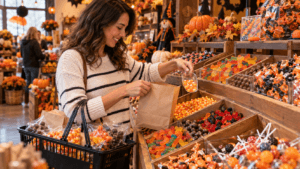
The children who come to your door range from toddlers in strollers to teenagers who are very nearly too old for the whole thing. A little thought about who is likely to visit will help you stock a bowl that works for everyone.
Every neighborhood has a legend about the house that gives out full-size bars. It makes children happy, but it is costly if you have many visitors. If you are considering it, weigh the cost against the size of your crowd. A compromise is to hand out fun-size pieces to most visitors and keep a small number of full-size bars for a special reason, such as a great costume or a group that arrives late. Fun-size candy is the practical choice for most households, because it is easy to count, cheap to buy in bulk and simple to hand out quickly.
Parents often worry about tampered candy, and it is sensible to be careful. In practice, the most useful habits are also the simplest: only accept commercially wrapped candy, inspect items at home and throw away anything that looks opened, unwrapped or unusual. Children should wait until they are home before eating anything so an adult can check the haul. Another common belief is that sugar alone makes children hyperactive. Many people report this connection anecdotally, but the excitement of the night, late bedtimes and the costumes are usually just as likely to explain a burst of energy. If you have concerns about your child’s health or diet, a pediatrician is the right person to ask.
If you enjoy a bit of creativity, you can turn ordinary candy into something special without spending much more.
Popularity varies by year and by region, and different surveys often give different results. Chocolate, fruity chews and lollipops are consistently common in bowls, and a mixed bag usually pleases the most people.
A mixed bag of fun-size pieces or a large bag of lollipops and chews gives good value. Compare the price per piece to find the best deal.
Many fruity and sour candies do not contain nuts, but formulations and manufacturing practices differ, so always check the label for allergen statements.
Estimate the number of visitors from last year, decide how many pieces each child will receive and add a buffer. It is better to have a little left over than to run out.
Stickers, pencils, glow sticks and small toys are popular choices, especially for children with allergies. Offering a choice between candy and a toy works well.
Buying in the last couple of weeks before Halloween usually gives you the best mix of selection and freshness. Buying earlier is fine if you can store it out of reach.
Store it in airtight containers, freeze chocolate, use it in baking or share it with coworkers or a local organization that accepts donations.
The best Halloween candy is the one that fits your household: something most kids will happily take, at a cost you are comfortable with, in a format that is safe and easy to hand out. For most people, that means a mix of chocolate, fruity candy and a budget-friendly filler, plus a few allergy-friendly or non-food options for kids who need them. Buy the right amount, store it well and enjoy the night.
For more ideas about the season, browse our Halloween collection, and if you are still working out costumes, take a look at our family Halloween costume ideas.