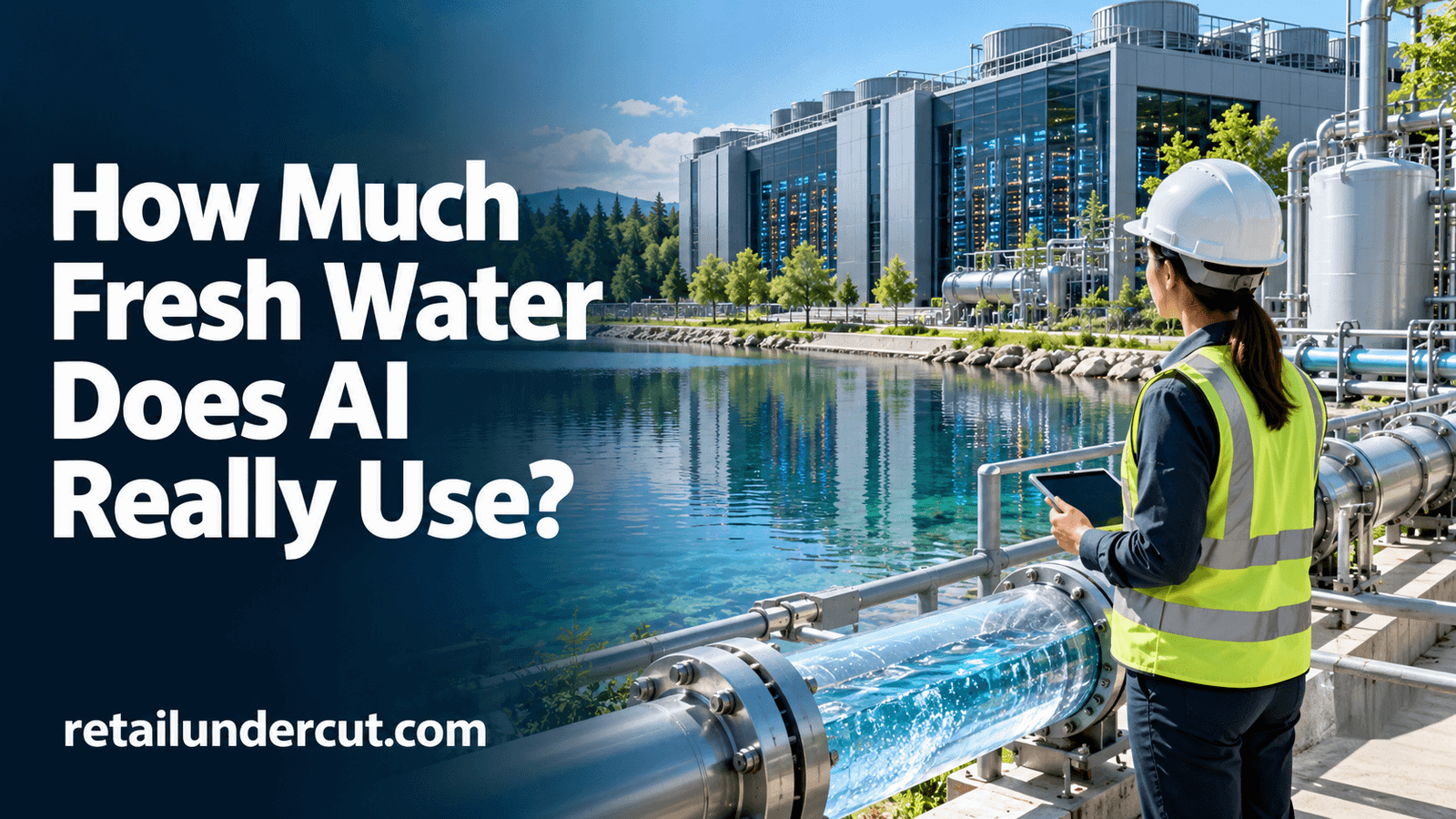
How much fresh water does AI really use? Estimates vary, but published research suggests training a single large language model can consume anywhere from hundreds of thousands to a few million liters of fresh water, largely for data center cooling, while individual queries after training are associated with much smaller amounts — often a fraction of a milliliter to a few hundred milliliters each. The distinction between fresh water specifically and water use broadly is an important, often-overlooked detail in this conversation.
This guide focuses specifically on fresh water — as opposed to reclaimed or non-potable water — and what the numbers actually show about AI’s reliance on it.
Why “Fresh Water” Specifically Matters
Not all water used in data center cooling comes from the same source. Fresh water — water suitable for drinking and other high-value uses — is a limited resource in many regions, and drawing heavily from it for industrial cooling can compete directly with agricultural, residential, and ecological needs. Reclaimed or non-potable water used for cooling has a very different impact profile, since it doesn’t compete with these higher-priority uses in the same way. This is why the “fresh water” framing specifically, rather than “water” generally, is often the more meaningful metric for evaluating environmental impact.
Training vs. Inference Water Use
AI water consumption breaks down into two very different phases. Training a large language model — the intensive process of teaching it from massive datasets — requires sustained, heavy computing over weeks or months, and is associated with substantial water use, sometimes estimated in the hundreds of thousands of liters or more for a single large model. Inference — running the model to answer individual user queries after training is complete — uses much less water per interaction, though it happens at enormous scale across millions of daily users. Both matter, but they’re genuinely different problems, and conflating them can distort the picture. For a closer look at query-level use, see how much water one ChatGPT search actually uses.
Does Location Affect Fresh Water Impact?
Significantly. A data center located in a water-stressed region — parts of the American Southwest, for example — has a much more meaningful fresh water impact than an identical facility located somewhere with abundant water resources. Some companies have specifically chosen data center locations partly based on water availability and cooling efficiency, while others have faced local pushback specifically because of fresh water concerns in drought-prone areas. This means the same technology can have very different real-world consequences depending purely on where its infrastructure is built.
How Do Companies Reduce Fresh Water Dependence?
- Air-based cooling. Some facilities rely more heavily on air cooling in cooler climates, reducing water dependence for temperature control.
- Reclaimed or non-potable water. Using treated wastewater or non-drinking-grade water for cooling avoids competing with fresh water supplies.
- Closed-loop cooling systems. Some systems recirculate water rather than continuously drawing new water, reducing net consumption over time.
- Water replenishment commitments. Some companies have pledged to return more water to local sources than their facilities consume, though the scope and verification of these programs vary.
For more on this specific strategy, see our piece on whether AI data centers actually recycle their water.
How AI’s Fresh Water Use Compares to Other Sectors
| Sector |
Fresh Water Relevance |
| Agriculture |
By far the largest global fresh water consumer |
| Data centers (including AI) |
Smaller in aggregate, but concentrated and growing quickly |
| Residential use |
Significant in aggregate, distributed across households |
| Manufacturing |
Highly variable, some sectors very fresh-water intensive |
Is the Trend Getting Better or Worse?
Both, depending on the specific metric. Per-query and per-model efficiency has generally improved as hardware and software optimization efforts continue, meaning the water cost of any single AI interaction tends to decrease over time. At the same time, total AI usage volume is growing rapidly, which can offset efficiency gains at the aggregate level. Understanding both trends together — improving efficiency alongside growing scale — gives a more complete picture than looking at either one in isolation. For the bigger-picture numbers behind this trend, see our full breakdown of whether AI is really using that much water.
Frequently Asked Questions
Does AI use more fresh water than other tech industries?
Not necessarily more per se — data center water use isn’t unique to AI, since traditional cloud computing and other server-heavy industries use water similarly. AI has drawn particular attention because of its rapid growth and prominence, not because its underlying infrastructure is fundamentally different from other data center use.
Can AI companies eliminate fresh water use entirely?
Some facilities have significantly reduced fresh water dependence through air cooling and reclaimed water systems, but eliminating it entirely across the industry isn’t currently the norm, and remains an ongoing engineering and infrastructure challenge.
Is fresh water use the same everywhere AI operates?
No. It varies significantly by data center location, local climate, and the specific cooling technology used, which is why location-specific analysis matters more than industry-wide averages for understanding local impact.
The Bottom Line
AI’s fresh water use is real and worth tracking carefully, but it varies enormously by training versus inference, by data center location and climate, and by the specific cooling technology in use. Broad, single-number claims about AI’s fresh water footprint tend to obscure more than they reveal — understanding the training/inference distinction and the role of location gives a far more accurate picture of where the actual impact is concentrated.