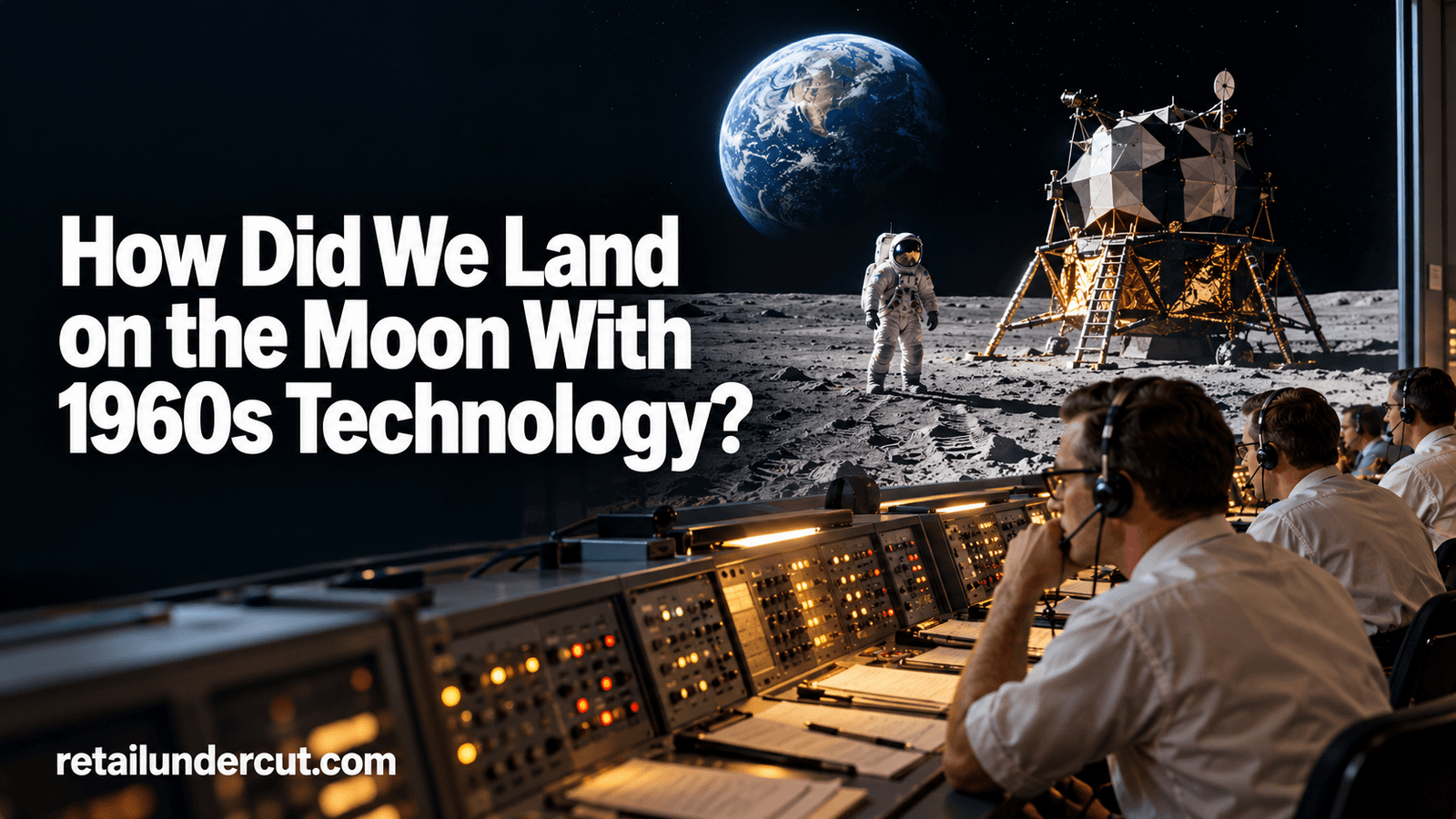
How did we land on the moon with 1960s technology? The short answer: not through raw computing power — the Apollo Guidance Computer had a tiny fraction of the processing power of a modern smartphone — but through an extraordinary combination of engineering discipline, redundancy, rigorous testing, and skilled human judgment that compensated for what the hardware of the era couldn’t do on its own.
This guide breaks down exactly how NASA pulled off the Apollo moon landings with technology that, by today’s standards, looks almost impossibly limited.
The Apollo Guidance Computer Was Incredibly Limited by Today’s Standards
The Apollo Guidance Computer (AGC) that flew astronauts to the moon had roughly 4 kilobytes of RAM and about 72 kilobytes of read-only memory. For comparison, a modern smartphone has memory and processing power that outstrips the AGC by many orders of magnitude — even a basic modern calculator app runs on more computing capability than what guided Apollo to the lunar surface. The comparison sounds almost absurd until you understand that the “brain” of a computer doesn’t need to be powerful in an absolute sense — it needs to be powerful enough for the specific, well-defined tasks it’s assigned, and NASA engineers designed the AGC’s tasks with extreme precision to fit within those tight constraints.
Purpose-Built Software Instead of General-Purpose Power
Unlike a modern computer running countless background processes, the AGC ran a small, extremely purpose-built set of programs designed to do exactly what the mission required and nothing more. Software pioneer Margaret Hamilton led the team that developed this software, and much of its brilliance lay in what it didn’t try to do — it wasn’t a general-purpose machine, it was a mission-specific tool, and every line of code existed for a clear operational reason. This narrow focus meant the limited hardware could be used with remarkable efficiency, since there was no wasted overhead running anything unrelated to the flight.
Priority-Based Processing Saved the Landing
One of the most famous moments in Apollo history came during the Apollo 11 lunar descent, when the AGC began throwing “1202” and “1201” program alarms as it approached the surface. Rather than being a catastrophic failure, this was the computer’s priority-scheduling system working exactly as designed: when the system became overloaded with more tasks than it could process, it was built to drop lower-priority tasks and keep executing the critical ones needed for landing. This design decision — building in graceful overload handling rather than assuming the hardware would never be pushed to its limits — was exactly the kind of engineering foresight that made success possible despite constrained hardware.
Redundancy Was Built Into Nearly Everything
NASA’s engineering culture around Apollo treated redundancy as a core design principle rather than an afterthought. Critical systems typically had backup systems, and those backups often had their own backups. The Lunar Module and Command Module each carried independent guidance computers, so a failure in one spacecraft’s system wouldn’t necessarily doom the mission. This layered redundancy meant that when individual components inevitably had issues — as complex hardware always does — the mission could continue rather than failing outright.
Extensive Simulation and Testing Reduced Real-World Risk
Long before any astronaut sat in a capsule, mission profiles were tested extensively through simulations, physical mockups, and unmanned test flights. Every procedure, every contingency, and every conceivable failure mode was rehearsed repeatedly on the ground. This exhaustive preparation meant that when something did go wrong in flight — as happened on several missions — the astronauts and mission control team had typically already trained for a similar scenario, reducing the chance that any single hardware limitation or malfunction would become an unrecoverable crisis.
Human Skill Compensated for Machine Limitations
Astronauts trained extensively to manually fly and navigate spacecraft if automated systems failed or needed correction. This wasn’t a backup plan of last resort — it was baked into how missions were planned from the start. During Apollo 11’s final descent, commander Neil Armstrong took semi-manual control to steer past a boulder field the automated system was heading toward, something that would have been impossible if the mission had depended entirely on automated systems working perfectly. The technology of the era wasn’t capable of doing everything, so mission design deliberately kept skilled humans in the loop for the judgment calls machines of that era couldn’t reliably make.
Ground-Based Computing Supplemented the Spacecraft
The onboard computer wasn’t working alone. Mission Control in Houston had access to significantly more computing power on the ground, along with a large team of specialists continuously monitoring telemetry and running calculations that the spacecraft’s onboard systems weren’t tasked with handling. This division of labor — minimal, mission-critical computing onboard, paired with heavier analysis and monitoring on the ground — let the overall system accomplish far more than the spacecraft’s limited hardware could have managed in isolation.
How Apollo-Era Technology Compares to Today
| Metric |
Apollo Guidance Computer (1960s) |
Typical Modern Smartphone |
| RAM |
About 4 KB |
Several GB (millions of times more) |
| Storage |
About 72 KB (read-only) |
Dozens to hundreds of GB |
| Processing approach |
Narrow, mission-specific tasks |
General-purpose, multitasking |
| Error handling |
Priority-based task shedding |
Modern OS-level process management |
Why This Still Matters
The Apollo program is often cited as proof that raw computing power isn’t the only path to solving extraordinarily hard problems. Careful system design, redundancy, rigorous testing, and human expertise can compensate for hardware limitations in ways that remain relevant well beyond spaceflight — the same principles show up in how engineers build reliable systems today, even though the hardware itself is no longer remotely comparable.
Frequently Asked Questions
Did NASA really land on the moon with less computing power than a calculator?
In terms of raw memory and processing capability, yes — the Apollo Guidance Computer had a small fraction of the computing power found in even simple modern devices. What made the mission succeed wasn’t raw power, but how precisely and efficiently that limited power was used.
What would have happened if the AGC had failed completely?
Built-in redundancy meant multiple independent guidance systems existed across the Command and Lunar Modules, and astronauts were trained to fly key procedures manually if needed. A complete, simultaneous failure of all backup systems was considered extremely unlikely given this layered approach.
Who wrote the software for the Apollo missions?
A team led by Margaret Hamilton at MIT’s Instrumentation Laboratory developed the flight software, including the priority-scheduling system that famously handled the 1202 program alarms during the Apollo 11 landing without aborting the mission.
The Bottom Line
Landing on the moon with 1960s technology wasn’t about having powerful computers — it was about extreme engineering discipline: purpose-built software, layered redundancy, exhaustive testing, and skilled humans ready to take over when automated systems reached their limits. It remains one of the clearest examples in history of thoughtful system design accomplishing what raw hardware specifications alone never could have.