

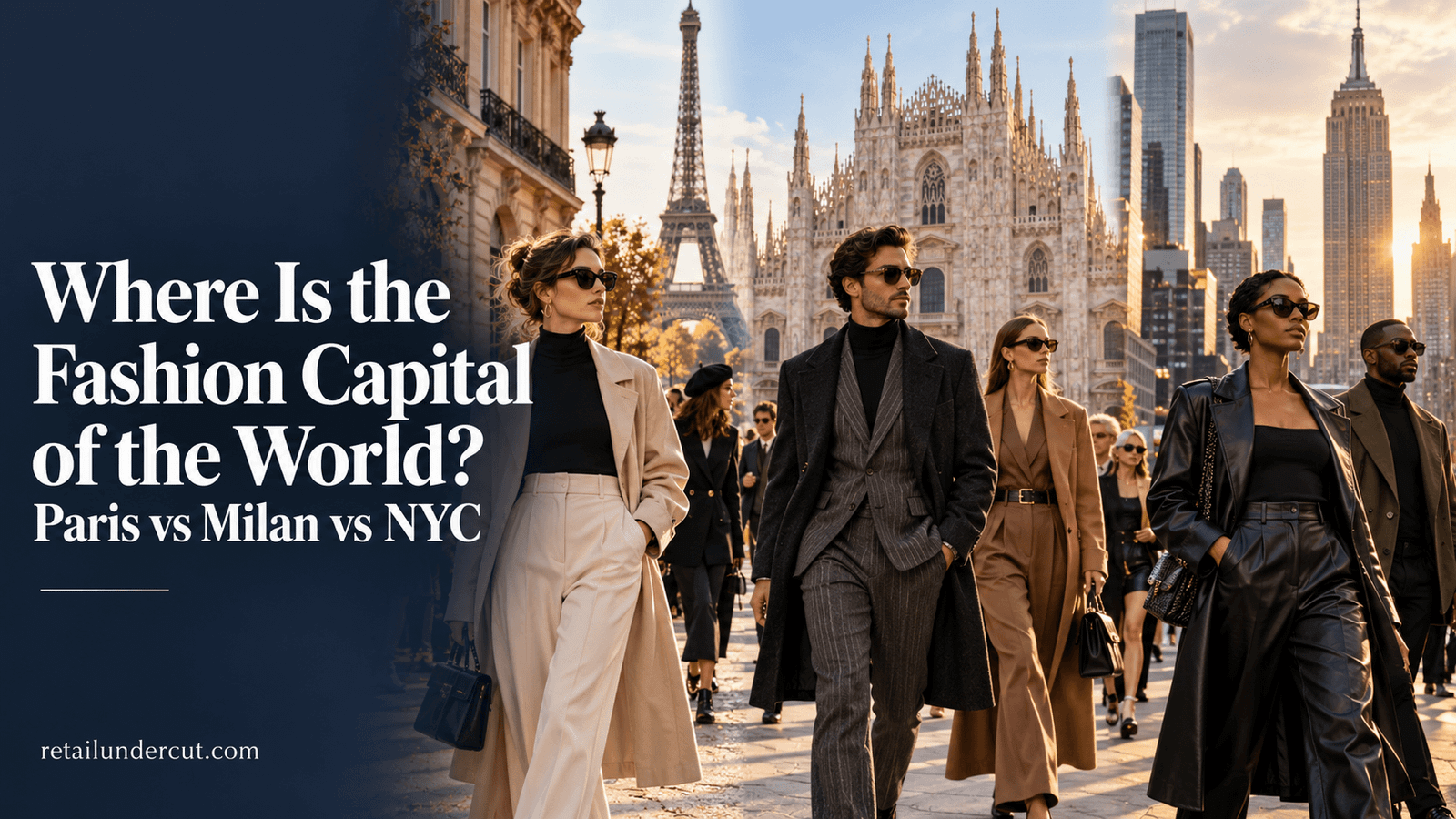
Ask a stylist in Paris and they’ll tell you, without blinking, that Paris is the fashion capital of the world — full stop, conversation over. Ask someone who works in the Garment District in New York, and you’ll get a very different answer. So what is the fashion capital of the world, really? The truth is that “fashion capital” isn’t a title with one official owner; it’s a role that four cities — Paris, Milan, New York, and London — have shared, argued over, and redefined for more than a century.
It’s one of those debates that never really gets settled, mostly because everyone involved — journalists, designers, tourists, retailers — is quietly measuring something slightly different when they use the phrase. That’s exactly why this guide exists: to separate the historical reasoning from the marketing spin, and to give you a clear, practical answer whether you’re planning a trip, researching the fashion industry, or just settling an argument with a friend.
If you’re asking which city sets the pace for haute couture and luxury heritage, the answer is Paris. If you’re asking which city dominates ready-to-wear craftsmanship and manufacturing, it’s Milan. If you’re asking which city moves the most product and has the deepest commercial fashion industry, that’s New York. And if you’re asking where the most experimental, boundary-pushing young design talent comes from, London usually wins that argument. Let’s break down how each city earned its reputation, how the rankings actually work, and which one deserves your attention depending on what you care about.
The concept of a “fashion capital” traces back to 19th-century Paris, when English-born designer Charles Frederick Worth opened his couture house and essentially invented the modern fashion designer as we know the role today — someone who creates original collections under their own name, shown to clients on a seasonal schedule, rather than simply tailoring to individual requests. That model became the template the rest of the industry eventually copied, and it’s a big part of why Paris still carries outsized symbolic weight.
Milan’s rise came later, accelerating through the mid-20th century as Italy rebuilt its manufacturing base after World War II and leaned into its deep textile and leatherworking traditions, particularly in the Lombardy region surrounding the city. New York’s fashion identity solidified around the same period, driven initially by necessity — with Europe’s fashion capitals cut off during wartime, American designers and retailers had to build their own show system, and the habit stuck long after the war ended. London’s fashion reputation took the longest to formalize into a globally recognized fashion week, gaining real international momentum in the 1980s and 1990s as it became known for producing radical, headline-grabbing young talent out of schools like Central Saint Martins.
Understanding this history matters because it explains why each city’s fashion identity still reflects its origin story: Paris as art and heritage, Milan as craft and manufacturing, New York as commerce and necessity, London as youth and rebellion.
Fashion isn’t just a creative industry in these cities — it’s a massive economic engine. New York’s fashion industry alone supports hundreds of thousands of jobs across design, manufacturing, retail, and logistics, and the Garment District has been a defined economic zone in Manhattan for over a century. Milan’s fashion and textile sector is one of the most important contributors to the broader Lombardy regional economy, supporting an enormous supply chain of specialized ateliers, tanneries, and textile mills that few other regions in the world can replicate at the same level of craftsmanship.
Paris’s luxury sector, anchored by conglomerates that own dozens of heritage houses, represents one of France’s most valuable export categories, and luxury goods remain a significant driver of the broader French economy. London’s fashion industry, while smaller in raw commercial output than the other three, punches above its weight in terms of creative and educational influence — its design schools export talent that ends up leading creative departments at fashion houses headquartered in all three of the other capitals, which is its own form of soft economic power.
Beyond the big luxury houses, each capital has a distinct roster of names that shape its identity season after season. In Paris, alongside heritage houses, contemporary voices continue to redefine what French fashion means to a new generation of shoppers. Milan’s design scene remains anchored by family-run houses that have stayed remarkably consistent in their design philosophy across decades, prioritizing recognizable silhouettes and materials over trend-chasing. New York’s designer landscape leans heavily toward those who understand the American customer’s preference for versatility — pieces that transition from office to evening without a full outfit change. London continues to produce some of the industry’s most talked-about graduate collections each year, several of which go on to define entire seasons of trends across all four cities within a few years of a designer’s runway debut.
If fashion tourism is part of your travel plans, knowing where to actually shop matters as much as knowing the history. In Paris, Le Marais offers a mix of independent boutiques and concept stores alongside the grand flagship stores along Avenue Montaigne. Milan’s Quadrilatero della Moda (the “Fashion Quadrilateral”) concentrates the city’s luxury boutiques into a compact, walkable few blocks, while the outlying towns around Milan host some of Europe’s most respected outlet shopping for last-season luxury pieces. New York spreads its fashion geography more widely — SoHo for flagship luxury stores, the Lower East Side for emerging independent designers, and the Garment District itself for a more industrial, wholesale-facing side of the business most tourists never see. London’s fashion neighborhoods split between the polished retail of Bond Street and the more experimental, independent shops scattered through Shoreditch and Dalston.
For anyone curious about the actual experience: official fashion week shows are, for the most part, industry-only events requiring an invitation — buyers, press, and clients rather than the general public. That said, all four cities host substantial public-facing energy around the official calendar: street style photographers camped outside the venues, pop-up brand activations, and a general surge of fashion-forward crowds in specific neighborhoods during the roughly week-long stretch each city hosts its shows. If you’re planning a trip specifically to experience the fashion week atmosphere without official access, timing your visit to coincide with the public-facing events and simply being present in the neighborhoods around the main venues delivers a surprising amount of the experience.
The idea of the “Big Four” goes back to the mid-20th century, when Paris, Milan, New York, and London emerged as the cities hosting the most influential fashion weeks — the twice-yearly showcases where designers present their collections to buyers, press, and increasingly, the public. These four cities still host the shows that set the global fashion calendar, and being invited to show during “fashion month” (the roughly six-week stretch each February/March and September/October when all four cities host their weeks back to back) remains one of the biggest signals of a designer’s arrival.
But the Big Four framework is also a little outdated. It reflects a 20th-century idea of fashion power concentrated in Western Europe and the U.S., and it doesn’t fully account for the growing influence of cities like Seoul, Tokyo, and Shanghai. Still, when people ask “what is the fashion capital of the world,” they’re almost always asking about this historic four-way rivalry — so that’s where we’ll start.
Paris has the strongest historical claim to the title. It’s home to the Chambre Syndicale de la Haute Couture, the official body that governs which houses are legally permitted to call their work “haute couture” — a strictly regulated designation tied to hand-craftsmanship, made-to-measure construction, and a minimum number of employees and pieces per collection. Houses like Chanel, Dior, and Yves Saint Laurent all built their legacies here, and couture week in Paris remains the pinnacle of the fashion calendar in terms of prestige, even if it moves the least product commercially.
Paris’s strength is heritage and artistry. It’s the city most associated with the idea of fashion as high art rather than pure commerce, and that reputation still carries enormous weight with luxury consumers worldwide.
Milan built its reputation differently — through manufacturing excellence and ready-to-wear (prêt-à-porter) rather than couture. Italy’s textile and leather industries are genuinely world-class, and Milan is home to powerhouse houses like Gucci, Prada, Versace, and Armani. Milan Fashion Week tends to emphasize polish, tailoring, and luxury materials over avant-garde experimentation.
If Paris represents fashion as art, Milan represents fashion as masterful craft — impeccably constructed clothing built on generations of textile and leather expertise concentrated in the surrounding Lombardy region.
New York’s claim to the title rests on scale and commercial power. It’s home to the largest fashion industry by revenue in the world, anchored by the Garment District, and it was the first city to establish a coordinated fashion week back in 1943 (originally created to draw attention away from Paris during World War II, when European shows weren’t accessible). American design tends to prioritize wearability, sportswear influence, and commercial viability — think Ralph Lauren, Calvin Klein, and Michael Kors — over the more theatrical runway presentations you’ll see in Paris or Milan.
New York also claims a strong cultural argument: it’s arguably the birthplace of modern street style as a documented, photographed phenomenon, thanks in part to photographers who turned sidewalk style outside the shows into its own form of fashion media.
London rounds out the Big Four as the experimental wildcard. It’s the city most associated with pushing boundaries — the launching pad for designers like Alexander McQueen and Vivienne Westwood, and home to Central Saint Martins, widely considered one of the most influential fashion schools in the world. London Fashion Week is smaller than the other three in commercial terms but punches well above its weight in shaping what “next” looks like in fashion.
When you see headlines ranking the “official” fashion capital of the world, they’re usually based on a mix of measurable and subjective factors: media mentions and search volume, the number and prestige of fashion weeks and shows hosted, the concentration of major luxury headquarters, retail sales volume, and social media buzz during fashion month. Some rankings (like those historically compiled by outlets tracking global media mentions) have actually put London or New York ahead of Paris in specific years, which surprises people who assume Paris automatically wins by default.
The honest answer is that there’s no single governing body that assigns the title. It’s an ongoing, informal competition measured differently depending on who’s doing the measuring — which is exactly why the debate has lasted this long.
| City | Known For | Signature Houses | Best For |
|---|---|---|---|
| Paris | Haute couture, heritage luxury | Chanel, Dior, Saint Laurent | Artistry and prestige |
| Milan | Craftsmanship, ready-to-wear | Gucci, Prada, Versace | Tailoring and materials |
| New York | Commercial scale, sportswear | Ralph Lauren, Calvin Klein | Wearable, business-savvy design |
| London | Experimentation, emerging talent | Burberry, Alexander McQueen | Boundary-pushing creativity |
It’s worth spending a little more time on the cities most likely to reshape this conversation over the next decade. Seoul’s ascent has been remarkably fast, fueled by the global reach of Korean pop culture and a design scene that blends streetwear, minimalism, and technical innovation in a way that’s become genuinely influential on runways well beyond Korea. Seoul Fashion Week has grown from a regional event into something international buyers and press now factor into their travel calendars.
Tokyo’s influence works differently — less about a single unified “Tokyo look” and more about the city’s role as a laboratory for subcultures that eventually go global, from the deconstructed avant-garde tailoring pioneered by Japanese designers in the 1980s to the streetwear movements that continue to shape casualwear trends worldwide. Shanghai’s fashion week has expanded quickly alongside China’s growing luxury consumer market, and the city increasingly serves as a launchpad for both homegrown Chinese labels and international brands looking to establish a foothold in the region. Los Angeles occupies a different lane entirely — its influence comes less from a formal show calendar and more from its role as the epicenter of celebrity culture and entertainment, where red carpet moments and street style captured outside industry events can shape trends as fast as any runway show.
None of these cities has unseated the traditional Big Four in terms of formal industry infrastructure, but their cultural gravity is undeniable, and it’s part of why definitions of “fashion capital” are gradually shifting from a purely Western-European-and-American framework toward something more genuinely global.
Choosing a home fashion week isn’t arbitrary — brands typically show in the city tied to their origin, their target retail buyers, or their brand identity. A Korean streetwear label might show in Seoul to build domestic momentum before attempting an international showcase in Paris or Milan. An American ready-to-wear brand almost always shows in New York first, both for logistical reasons and because its core buyers are concentrated there. Some designers strategically show outside their “home” city specifically to signal ambition — a young American designer showing in Paris, for instance, is making a deliberate statement about wanting to be judged against European luxury standards rather than domestic commercial ones. This decision alone can shape how the industry perceives a brand’s positioning for years afterward.
Fashion month follows a set order twice a year: New York kicks things off, followed by London, then Milan, and finally Paris closes out the cycle. This sequencing isn’t random — it roughly follows a geographic and time-zone-friendly path for buyers, editors, and press who travel to all four cities back to back. Menswear and couture have their own separate, smaller calendar slots earlier in the year. If you’re ever trying to time a trip around the shows (even just to soak up the energy from outside the tents), knowing this order helps you plan which city to be in and when.
If you’re planning a fashion-focused trip rather than just reading about the rivalry, each city rewards a different kind of visitor. Paris is unmatched for flagship luxury boutiques, historic ateliers, and the sheer density of design museums like the Palais Galliera. Milan offers incredible outlet shopping in the surrounding region alongside its polished city-center boutiques. New York gives you the widest range, from the Garment District’s wholesale energy to SoHo’s flagship stores. London rewards those who want to discover emerging designers before they’re famous, particularly around areas like Shoreditch and Notting Hill.
If Paris is on your itinerary, our Paris summer packing guide is a useful next stop for planning what to actually bring, and our roundup of affordable French fashion brands can help you shop like a local without the couture-house price tag.
A few misconceptions come up constantly in this debate. First, “fashion capital” is not an officially awarded title — no governing international body hands out the crown, despite how confidently people state it as fact. Second, hosting a fashion week doesn’t automatically make a city a fashion capital; plenty of cities host shows without competing for the top tier. Third, commercial size and creative influence are different things entirely — New York wins on revenue, but that doesn’t make its shows more influential to the direction fashion actually takes each season, which is often set more by Paris and London.
If you need one answer: Paris holds the strongest overall claim, largely because of its historical role as the birthplace of haute couture and its continued dominance in luxury heritage and prestige. But it’s genuinely a four-way (arguably six-or-seven-way, counting the rising cities) conversation, and the “right” answer depends entirely on whether you’re measuring artistry, craftsmanship, commercial power, or creative disruption. Understanding your own personal style priorities can actually help clarify which city’s fashion philosophy resonates with you most — our guide on finding your personal style is a good next read if you want to translate any of this inspiration into your own closet.
What is officially the fashion capital of the world?
There’s no official governing title. Paris is the most commonly cited answer due to its haute couture heritage, but Milan, New York, and London are all legitimately part of the conversation depending on the criteria used.
Why is Paris considered the fashion capital?
Paris is home to the regulated haute couture designation and legendary houses like Chanel and Dior, giving it the strongest historical and prestige-based claim.
What are the Big Four fashion capitals?
Paris, Milan, New York, and London — the four cities that host the major fashion weeks each season and have historically dominated the global fashion industry.
Is New York or Paris the bigger fashion capital?
It depends on the metric. New York has the larger commercial fashion industry by revenue, while Paris holds more prestige and influence in luxury and haute couture.
Which cities are emerging as new fashion capitals?
Seoul, Tokyo, Shanghai, and Los Angeles are the most frequently cited rising fashion cities challenging the traditional Big Four.
What order do fashion weeks happen in?
New York first, followed by London, then Milan, and finally Paris — this order repeats twice a year during fashion month.
Can tourists attend fashion week shows?
Official runway shows are typically invitation-only for industry, press, and clients, but all four cities have significant public-facing energy — street style, pop-ups, and brand events — happening around the shows that anyone visiting can experience.
Is Milan or Paris better for luxury shopping?
Both offer world-class luxury shopping, but Milan’s Quadrilatero della Moda is more compact and walkable, while Paris spreads its flagship boutiques across a wider area, including Avenue Montaigne and Le Marais.
Will a new city ever replace the Big Four?
It’s unlikely any single city fully replaces the current four in the near term, but Seoul, Tokyo, and Shanghai are increasingly part of the global fashion conversation and could reshape the hierarchy over the coming decade.
How many fashion weeks are there each year?
Each of the Big Four cities hosts fashion week twice annually — once for fall/winter collections and once for spring/summer — plus separate, smaller calendar slots for menswear and haute couture.








Don’t miss a thing! Sign up to get new content sent directly to your inbox.