

Christmas in the United States is a blend of customs brought by immigrants from all over the world, reshaped by American inventiveness, commerce and pop culture. Dutch, German, English, Irish, Italian, Mexican and many other traditions have mixed together to create a holiday that feels uniquely American, from the red-suited Santa and the Christmas tree in the living room to NORAD tracking Santa’s sleigh and ugly sweater parties.
This guide explains the most important American Christmas traditions: where they came from, how they developed and how families celebrate them today. It also covers regional Christmas customs in the USA, from luminarias in New Mexico to bonfires on the Mississippi levee, so you can see how varied the holiday is across the country.
Christmas was not always widely celebrated in America. In colonial New England, Puritans viewed Christmas celebrations as unbiblical and rowdy. The Massachusetts Bay Colony banned celebrating Christmas from 1659 to 1681, fining anyone caught feasting. In other colonies, such as Virginia and New York, Christmas was celebrated with church services, feasting and visits.
In the nineteenth century, the holiday changed dramatically. Writers and artists helped reinvent Christmas as a family-centered, child-focused celebration:
By the early twentieth century, many of today’s American Christmas traditions were in place, and advertising, radio, film and television spread them nationwide.
| Period | Key developments |
|---|---|
| 1600s | Puritan New England discourages Christmas; Massachusetts bans it from 1659 to 1681 |
| Early 1800s | Washington Irving and “A Visit from St. Nicholas” reshape the holiday around family and children |
| 1840s to 1850s | Christmas trees spread from German American homes into the mainstream |
| 1860s to 1880s | Thomas Nast defines Santa; Christmas becomes a federal holiday in 1870; electric tree lights appear |
| 1920s to 1930s | National Christmas Tree (1923), Rockefeller Center tree (1931), Coca-Cola Santa ads |
| 1940s to 1960s | Classic songs and films, Toys for Tots, NORAD Tracks Santa (1955), TV specials |
| 1990s to today | Home Alone and Elf, ugly sweater parties, Elf on the Shelf, online shopping and streaming movie marathons |
Each generation has added something, which is why American Christmas traditions feel both old and constantly new.
Santa Claus is at the heart of American Christmas traditions, and his story shows how the holiday was built from many cultures. His name comes from the Dutch Sinterklaas, a version of St. Nicholas, the fourth-century bishop known for secret gift giving. Dutch settlers in New Amsterdam (now New York) are often credited with bringing the tradition, though historians note that it was New York writers in the early 1800s who really popularized the figure.
Santa appeared in many colors in early illustrations, but red became dominant by the early twentieth century. Coca-Cola’s advertisements, painted by Haddon Sundblom from 1931, did much to popularize the warm, grandfatherly image many Americans know today, though they did not invent the red suit.
American children write letters to Santa, sometimes mailed to the North Pole, and many visit a mall or department store Santa for a photo. The US Postal Service’s Operation Santa program lets volunteers answer letters and fulfill some children’s wishes. On Christmas Eve, children leave milk and cookies for Santa and often carrots for the reindeer.
The Christmas tree came to America with German immigrants, including Pennsylvania Germans in the eighteenth and nineteenth centuries. The custom became fashionable after an 1848 illustration of Queen Victoria and Prince Albert’s family around a decorated tree appeared in the press, and an Americanized version was reprinted in Godey’s Lady’s Book in 1850.
Today, a decorated tree is one of the most visible American Christmas traditions. Families choose between real trees, often cut at a local farm or bought from a lot, and artificial trees that last for years. If you are shopping for a tall tree, our 9 ft Christmas tree buying guide covers sizing, lights and styles.
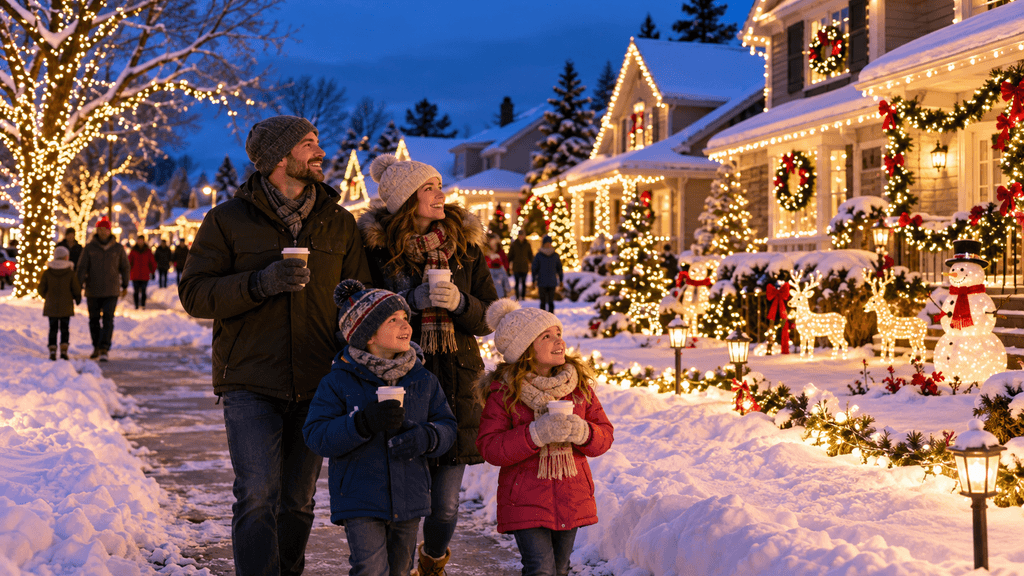
Elaborate outdoor lights are one of the most distinctive American Christmas traditions. Electric Christmas lights were introduced in the 1880s by Edward H. Johnson, a colleague of Thomas Edison, and became affordable for homes in the twentieth century. Today, some neighborhoods coordinate spectacular displays, and families drive around to see them. Famous examples include Dyker Heights in Brooklyn and many “Christmas light” streets across the country. To keep power bills in check, see our guide to smart home gadgets that save electricity.
Front-door wreaths, stockings hung by the fireplace and red poinsettias are standard decorations in American Christmas traditions. The poinsettia is named after Joel Roberts Poinsett, the first US minister to Mexico, who brought the plant to the United States in the 1820s. December 12 is National Poinsettia Day.
Many families treasure ornaments passed down through generations. Some collect vintage Santa figures and mid-century glass; our antique Santa decorations collector’s guide explains how to identify and care for them.
American Christmas traditions stretch across several weeks.
| Date | Tradition |
|---|---|
| Thanksgiving (fourth Thursday of November) | Macy’s Thanksgiving Day Parade ends with Santa’s arrival, marking the start of the season |
| Black Friday and Cyber Monday | Christmas shopping begins in earnest |
| Early December | Tree lightings, decorating, holiday parties, cookie baking |
| December 24 | Christmas Eve services, family dinners, NORAD Santa tracking |
| December 25 | Stockings, presents, Christmas dinner, movies |
| December 31 | New Year’s Eve parties close the season |
Shopping is a big part of the season. Our guides to Black Friday vs Cyber Monday and early Black Friday deals explain how to shop smart.
Christmas Eve church services, including candlelight services and midnight Mass, are among the most widely observed American Christmas traditions for Christian families.
In 1955, a Sears advertisement in Colorado Springs printed a phone number for children to call Santa, but a misprint connected them to the Continental Air Defense Command operations center. Colonel Harry Shoup told his staff to give children Santa’s location, and a tradition was born. Today NORAD, the North American Aerospace Defense Command, runs a website, apps and phone lines on Christmas Eve, answering calls from children around the world.
Among smaller American Christmas traditions, many families let children open one present on Christmas Eve, often new pajamas. Matching family pajamas have become a popular photo tradition; see our family Christmas pajamas guide.
Italian American families often celebrate Christmas Eve with the Feast of the Seven Fishes, a seafood dinner rooted in southern Italian traditions of avoiding meat before Christmas.
On Christmas morning, children find stockings filled with small gifts and presents under the tree from Santa and family. Gift exchanges continue through the day.
There is no single dish that defines food in American Christmas traditions. Because turkey is closely tied to Thanksgiving, many families serve ham, prime rib, roast beef or a second turkey. Regional and immigrant dishes are common: tamales in Texas and the Southwest, lasagna in Italian American homes, pierogi in Polish American families. Compare this with the history of the traditional English Christmas dinner, where goose once ruled.
For many Jewish Americans and others who do not celebrate Christmas, December 25 means Chinese food and a movie, a tradition over a century old. Read the story in our guide to Chinese restaurants open on Christmas Day.
Watching holiday films is one of the most beloved American Christmas traditions. Classics include It’s a Wonderful Life, Miracle on 34th Street, A Christmas Story, Home Alone, Elf and animated specials like A Charlie Brown Christmas and How the Grinch Stole Christmas. Cable networks run marathons, and new holiday romance movies arrive every year.
Music is woven through American Christmas traditions. Many of the best-known holiday songs were written by Americans in the twentieth century: “White Christmas” by Irving Berlin, “Have Yourself a Merry Little Christmas,” “Rudolph the Red-Nosed Reindeer,” “Jingle Bell Rock,” “Rockin’ Around the Christmas Tree” and “All I Want for Christmas Is You.” Even “Jingle Bells” was written by an American, James Lord Pierpont, and was originally connected to Thanksgiving. Radio stations switch to all-Christmas formats in November, churches and schools stage concerts and carolers still go door to door in some neighborhoods. Performances of Handel’s Messiah and The Nutcracker ballet are annual American Christmas traditions in many cities.
For many families, Christmas afternoon means watching the NBA’s showcase slate of Christmas Day games, a tradition going back decades. In recent years the NFL has also scheduled Christmas Day games. College football bowl season is in full swing, too, making sports a common backdrop to Christmas customs in the USA.
The idea of a snowy Christmas is central to the American imagination, thanks partly to songs and movies. In reality, the chance of snow on the ground on December 25 varies hugely: it is common in the northern Rockies, upper Midwest and northern New England, and rare across the South, Southwest and much of California. Many Americans celebrate in shorts in Florida, Texas or Hawaii, and families in warm states adapt American Christmas traditions with beach walks, outdoor barbecues and palm trees wrapped in lights.
Once an embarrassing gift, the “ugly Christmas sweater” became a party theme in the 2000s and is now a mainstream tradition, with contests at offices and schools. For more party ideas, see our guide to office Christmas party games.
Based on a 2005 book, the Elf on the Shelf is a small scout elf that “watches” children and moves around the house each night. It has become one of the most popular modern American Christmas traditions.
Office and friend-group gift exchanges such as Secret Santa and White Elephant are standard parts of the season.
Gift giving is central to how Americans celebrate Christmas, and the shopping season is a tradition of its own. Many families set a budget, draw names for adult gift exchanges and shop for deals from Black Friday through mid-December. Gift cards, experiences and handmade gifts have become popular alternatives to piles of wrapped boxes. For online shopping, see our guides to Cyber Monday on Amazon and smart ways to find online deals.
Sending cards is one of the oldest American Christmas traditions. Americans send millions of Christmas cards, including family photo cards and year-end letters.
Giving back is one of the most meaningful American Christmas traditions. Many families volunteer at food banks, shelters and toy drives, such as the Marine Corps Reserve’s Toys for Tots program, which began in 1947.
One of the richest parts of American Christmas traditions is regional variety.
| Region | Tradition |
|---|---|
| New Mexico and the Southwest | Luminarias or farolitos: paper bags with sand and candles lining streets and rooftops |
| Louisiana | Bonfires on the Mississippi levee on Christmas Eve to light the way for Papa Noël |
| Pennsylvania | Moravian stars and the Christmas city of Bethlehem, Pennsylvania |
| Hawaii | “Mele Kalikimaka,” Santa arriving by outrigger canoe and holiday luaus |
| Alaska | The town of North Pole, where letters to Santa are answered |
| Texas and California | Tamale-making gatherings (tamaladas) and Las Posadas processions |
| New England | Candlelight walks, historic inn celebrations and snowy village fairs |
| Michigan | The Christmas pickle ornament legend, celebrated in Berrien Springs |
| New York City | Rockefeller Center tree, store window displays and ice skating |
In many Mexican American communities, Las Posadas re-enacts Mary and Joseph’s search for shelter over nine nights from December 16 to 24, with processions, songs and celebrations.
Some American families hide a pickle-shaped glass ornament on the tree; the child who finds it gets an extra gift or good luck. Although it is often called a German tradition, it appears to be largely American.
The United States is religiously and culturally diverse, and December includes more than Christmas. Hanukkah, the Jewish festival of lights, often falls in December. Kwanzaa, created in 1966 by Maulana Karenga, runs from December 26 to January 1 and celebrates African American heritage and community values. Many families celebrate more than one holiday, and interfaith households often blend customs. That diversity is why “Happy Holidays” is a common greeting in American public life, and why many American Christmas traditions, such as lights, cookies and gift giving, are shared by people of different faiths and none.
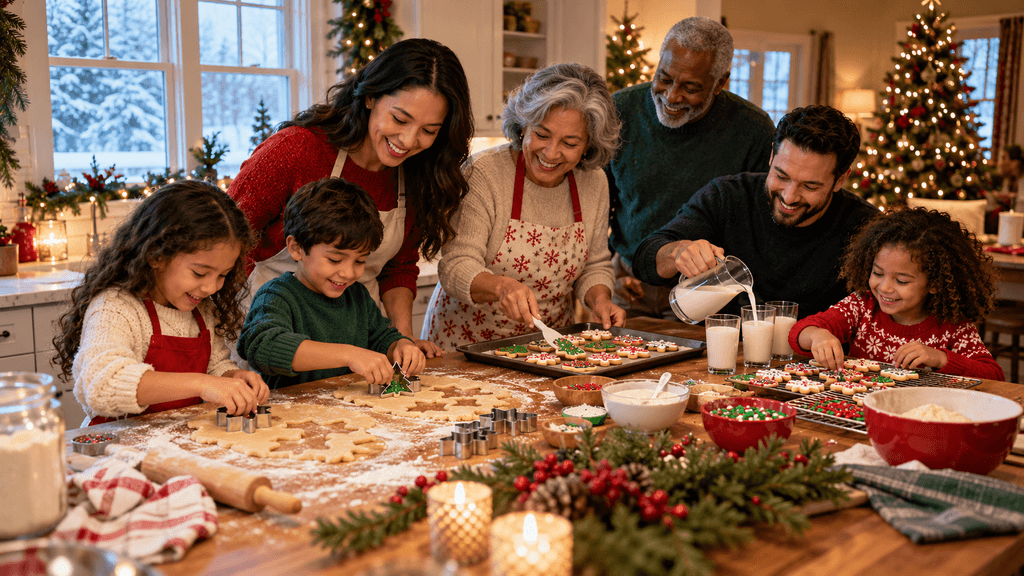
The best American Christmas traditions often begin with a single family. If you want to start something new this year, try one of these ideas:
Within a few years, these small rituals become the American Christmas traditions your children will remember and pass on.
American Christmas traditions borrow from many places but differ in focus. Compared with Ireland, where Christmas stretches to January 6 and customs like Wren Day and Women’s Christmas are important (see our traditional Irish Christmas guide), the American holiday tends to center on December 24 and 25. Compared with England, Americans rarely have Christmas crackers or Boxing Day, but they place more emphasis on outdoor lights and Christmas movies.
For millions of people, one of the defining American Christmas traditions is the trip home. The days around Christmas and New Year’s are among the busiest travel periods of the year on roads and at airports. Booking early, traveling on the holiday itself and packing light all help. Our guides to how far in advance to book a flight and TSA-approved carry-on luggage can make the journey easier.
Decorating a Christmas tree, putting up lights, hanging stockings, visiting Santa, exchanging gifts, watching Christmas movies, baking cookies and sharing a family dinner are among the most popular.
Americans typically celebrate with decorated trees and lights, church services, family meals, gift exchanges on Christmas morning, holiday parties and movies, with many regional and cultural variations.
Christmas became a federal holiday in 1870.
It is a tradition that began in 1955 when a misprinted phone number connected children to a military command center. Today NORAD tracks Santa’s journey online on Christmas Eve.
Most American Christmas traditions came from immigrant communities, especially Dutch, German, English, Irish, Italian and Mexican, and were reshaped by nineteenth-century writers, illustrators and later by advertising, film and television.
Luminarias in New Mexico, levee bonfires in Louisiana, Santa arriving by canoe in Hawaii, the Christmas pickle and ugly sweater parties are some of the most unusual.
Many do, but because turkey is central to Thanksgiving a month earlier, many families choose ham, beef or regional dishes for Christmas.
American Christmas traditions are a patchwork of immigrant customs, nineteenth-century storytelling and modern pop culture. From the Dutch roots of Santa Claus and the German Christmas tree to NORAD’s Santa tracker and ugly sweater contests, the holiday keeps evolving. What unites these Christmas customs in the USA is a focus on family, generosity and light in the darkest weeks of the year.
For more festive reading and ideas, explore our printable Christmas games for kids and family.